
Chapter 1
AEO/GEO core concepts 🗺️
- Introduction
- Chapter 1
- Chapter 2
- Chapter 3 (coming soon)
- Chapter 4 (coming soon)
Heads up: This chapter is a bit more conceptual and less hands-on than the others. Feel free to jump straight to chapter 2. But if you want a quick primer on what exactly is happening to traditional search (or just need a little extra fodder for a budget conversation with your boss), stay put.
This chapter will cover:

⊹ AI search trends
Let’s run through some numbers real quick:
AI search on platforms like ChatGPT, Claude, Gemini, Perplexity, Grok, and others is exploding in popularity. Google is cannibalizing its own results pages with AI Overviews. And traditional search traffic is plummeting for many brands.
Why?
Because people prefer fast, concise, zero-click answers to their questions instead of scrolling through a sea of blue links.
Here’s what that means for brands: Human beings are no longer your most high-value website visitors—the AI user agents searching on their behalf are.
When someone queries an AI platform, much of the time an agent searches the web (and the info it’s already indexed), extracts information, and serves it back to the user. That’s why your organic web traffic is dipping (or skewing more toward bots).
User behaviors are shifting to AI-first—people talk to large language models before they talk to you. Whether they actually land on your site or not depends on what an LLM returns to them.
This is what we mean when we say “AI-first customer journey.”
The good news: This isn’t necessarily a bad thing. Not if you’re making it easy for AI agents to surface helpful info for the humans on the other end of the prompt.
Our customers tell us that traffic from AI search converts at a higher rate and fuels revenue growth.
The catch: You have to capture AI traffic first.

⊹ What are the key differences between SEO vs. AEO/GEO?
Answer engine optimization (aka generative engine optimization) and search engine optimization share similarities (beyond two letters in their acronyms), but there are lots of differences:
| Dimension | SEO | AEO/GEO |
|---|---|---|
| User experience | Search and click on link to find answer | Search and stay on platform to receive answer |
| Answer output | Stack-ranked links | Text synthesized across reference sources, subdued links |
| Performance metrics | Impressions, keyword rankings, organic traffic | Brand presence, citations, referral traffic |
| Crawl method | Site indexing, re-crawls | Training, indexing, retrieval |
| Result variance | Relatively stable, differentiated by user history | Fluctuates based on platform, AI agent memory |
| Industry expertise | Established category with proven methodologies | Nascent category with no definitive methodologies |
AI search compresses the workflow of traditional search, having the AI agent do more of the heavy lifting on behalf of the person behind the prompt:
- Traditional search flow: Query search engine → See list of results → Click result → Go to website → Leave website → Click other result → Repeat until finished
- AI search flow: Ask LLM → Receive response → Repeat until finished
The objective of SEO is to increase your visibility in search engines so that a human being will click on your site and learn more about your products and services.
The objective of AEO/GEO is to increase the likelihood that an LLM will reference or suggest your products and services to fulfill a user prompt—and say the right things when it does.
AI search doesn’t lead to a customer experience—it is the customer experience. And it doesn’t just help people detect your brand, it defines it for them.
Plus there’s no magic ranking algorithm across AI platforms. People will get different results based on:
- LLM model
- Geographic location
- Customization
- Memory
- Feature flags
- Etc.
Put another way: Any company that promises to help you “rank #1 in AI search in just 3 easy steps” is missing the forest for the trees (or selling snake oil).
All that being said, if you’re doing SEO well, you likely already have a leg up in AI search.
When someone asks an LLM a question, a go-to source of a retrieval agent is content from the top results of SERPs. The LLM will then use a mix of those results to try to provide the best answer based on the intent of the user’s prompt.
In this way, AI search relies on traditional search algorithms.
But SEO and AEO/GEO are not one-to-one. There's no guarantee that ranking No. 1 in Google will consistently get you mentioned by an LLM.
And if you don't have visibility into AI search, there's no way to gauge your performance, let alone improve it.
⊹ The AI search maturity curve
No matter where you sit, the AI search maturity curve highlights the basic foundations of improving AI search performance:
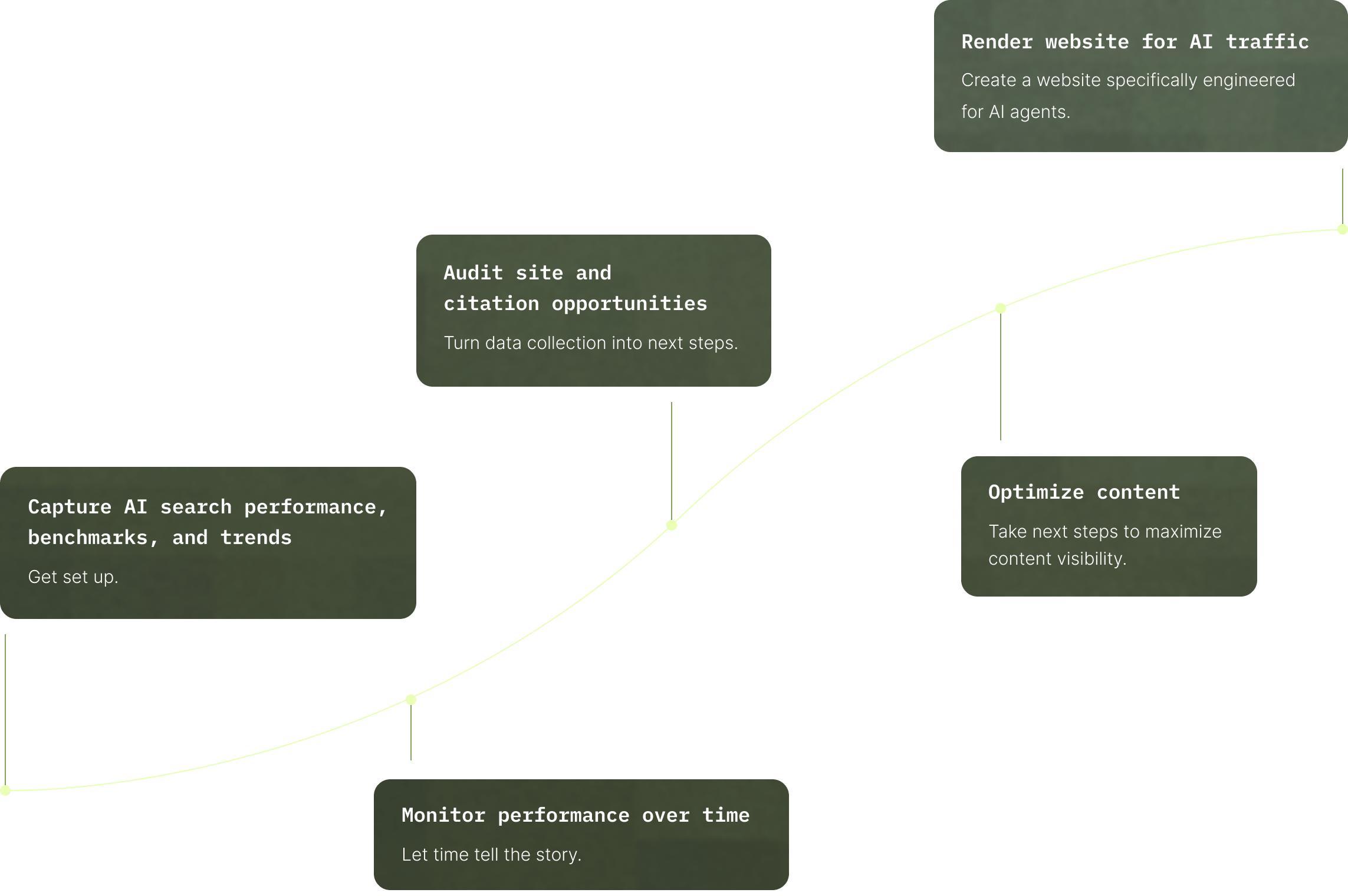
Our goal with this guide is to get you most of the way through the curve.
We’re not saying you’ll be an expert after finishing this guide (no one really is at this point), but you’ll have a strong grasp of the fundamentals and plenty of new tactics to put into practice.
Phases of the maturity curve include:
Phase 1: Capture AI search performance, benchmarks, and trends
This phase is all about getting set up.
You need to choose which prompts to track, which personas to model, which competitors to compare yourself to, which topics to group, and so on. We’ll cover this phase in chapter 2.
Phase 2: Monitor performance over time
This phase is all about letting time tell the story.
You need to understand if your AI search presence is growing over time, how you’re stacking up against relevant brands in your space, whether your brand is showing up for high-value prompts, whether you’re seeing meaningful conversions, and so on. We’ll cover this phase in chapter 2.
Phase 3: Audit site and citation opportunities
This phase is all about turning data collection into next steps.
You need to understand how to improve your AI search presence and what to prioritize first.
Sometimes this is technical, like improving website crawlability and page speed. Sometimes it’s more strategic, like seeing where the lowest-hanging citation opportunities are and updating content accordingly. We’ll cover this phase in chapter 3.
Phase 4: Optimize content
This phase is all about taking steps to maximize content visibility in AI search.
While this process is somewhat of a black box (there’s no real guidance from AI platforms on how to boost citations), in general, you want to serve the agents that are serving the humans behind a prompt.
That includes things like structuring content with the schema and markup language that AI agents prefer (markdown and JSON, not JavaScript), establishing credibility with authorship wherever possible, getting content published by credible third-party sources, and so on. We’ll cover this phase in chapter 3.
Phase 5: Render website for AI traffic
This phase is all about creating a website specifically engineered for AI agents versus trying to optimize for both agents and human visitors.
That means creating a parallel version of your site that serves up content to AI agents in the format they prefer to maximize performance without damaging the integrity of the human user experience. We’ll cover this phase in chapter 4.
And that’s chapter 1 done. In chapter 2 we’ll walk you through the ins and outs of monitoring, from core KPIs to tracking prompts, user agents, and search volume.
Monitoring 🔭
Chapter 2
- What are the key differences between SEO metrics vs. AEO/GEO metrics?
- How do I track AI search metrics?
- What are the core KPIs for tracking AI search performance?
- Mapping out brand-specific dimensions
- AI search monitoring tips
- Prompt tracking framework
- How do I source prompts?
- How do I track and analyze prompts?
- How do I track AI agent traffic?
- How do I track AI search volume?