Agent Experience
Monitoring & Insights




YouTube influencers have an AI audience: What millions of citation events reveal about influencer sponsorships
TLDR:
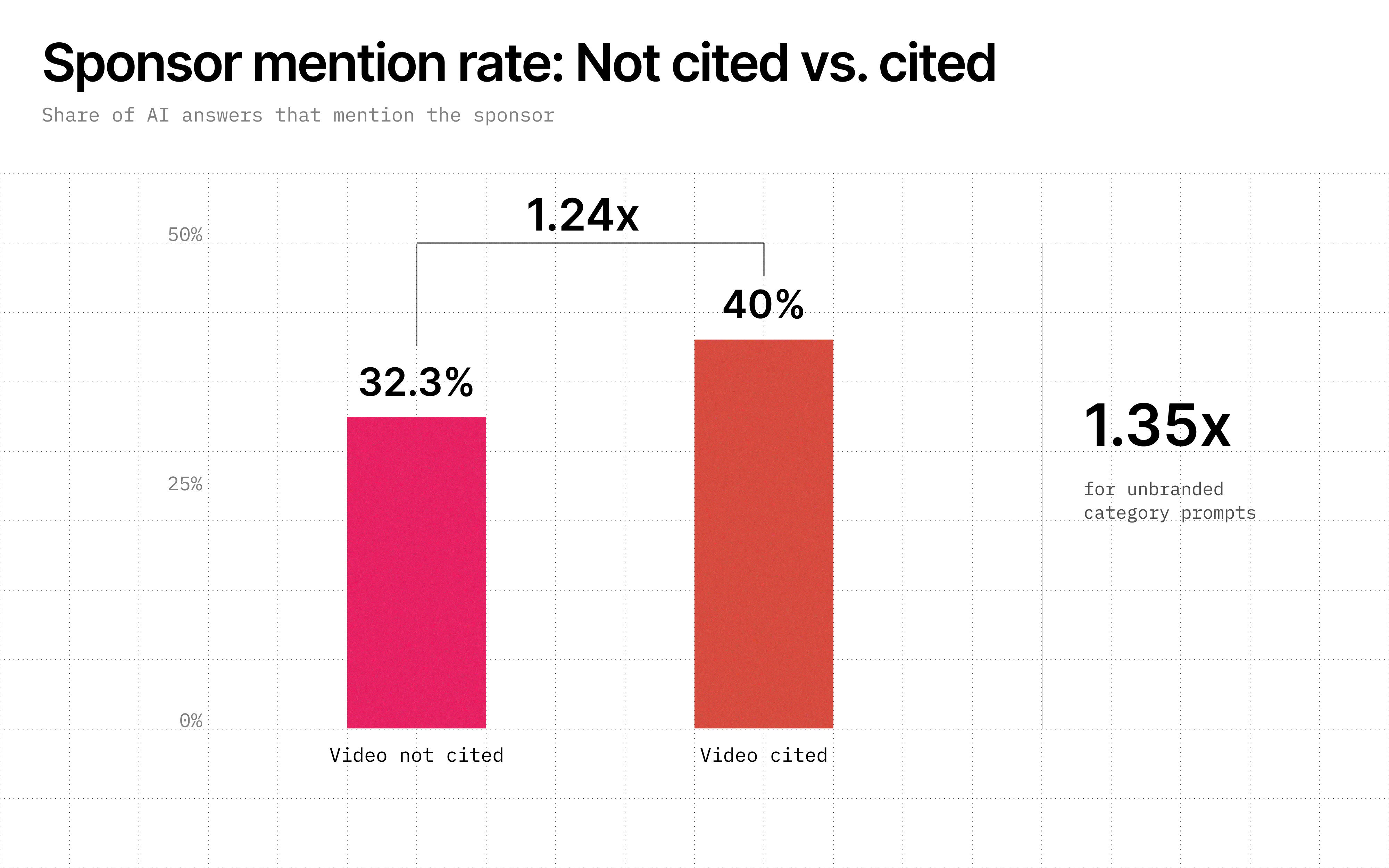
- When AI cites a YouTube video with a description that names a sponsor, that sponsor gets mentioned in the answer about 1.24x more often (40% of the time versus 32.3%). On unbranded category prompts, the lift grows to 1.35x.
- The effect lives primarily in the four platforms most likely to cite YouTube: Google AI Mode, Google AI Overviews, Perplexity, and Gemini.
- YouTube citations fade by more than 40% within a month, but the sponsor-named-if-cited effect remains strong over the same time period.
YouTube is increasingly spotlighted as a top citation source in AI search.
Our own research previously found that it’s a strong cross-industry generalist: YouTube popped up as a top 10 source across automotive, retail, technology, and other industries.
Whether or not it’s uniquely influential for your business depends on your category, your niche within it, and the prompts you’re tracking, but there’s no denying that YouTube is a powerful lever for brands.
Not just in terms of AI answers, but also in terms of sponsored content (it’s estimated that brands will spend approximately $3B-$6B on YouTube influencers in 2026).
Which got us thinking: When a brand pays a YouTuber to mention them in a video, and that video later shows up as a source in an AI answer, does the sponsor benefit as well?
We wanted to understand how sponsored YouTube content travels into AI answers when videos enter retrieval, so we measured three months’ worth of multi-AI assistant search data (May 2026 to July 2026) covering thousands of sponsored videos, hundreds of brands, and millions of citation events.
You can dig into our findings below.
The big takeaway? Sponsored YouTube content can boost your brand even after human viewers hit pause.
What do we mean by sponsored content?
This study is specifically about sponsorship information reflected in YouTube video descriptions ("thanks to Brand X for sponsoring"-style mentions in the text under a video), not pre-roll/mid-roll ads or other YouTube monetization channels.
YouTube sponsors ride along in AI answers
To cut to the chase: Yes, sponsored YouTube videos can carry sponsor names into AI answers.
We analyzed the same question asked of the same AI assistant on different occasions. When the answer cited a sponsored video, the sponsor got named about 40% of the time. When it didn’t, about 32.3%. That’s a 1.24x lift.
The effect is even stronger for unbranded category prompts. When someone asks an AI a question and doesn’t name the brand, and the AI cites the brand’s sponsored video, sponsors see a 1.35x lift.
It’s worth being clear that this is what happens in answers where AI picks a sponsored video as a source. It’s not what a sponsorship deal is worth in AI search automatically. Whether YouTube pays off this way for a given campaign depends on how many relevant questions people are asking and how often a video gets cited.
We ran our analysis with an unrelated brand swapped in for the sponsor (a placebo brand). The effect disappeared, so this isn't just AI answers naming more brands whenever they cite a commercial (aka brand-heavy) video.
What we can't separate is payment from placement. A brand that’s name sits high in YouTube description text, is repeated, and is next to a discount code might get a similar bump without a dollar changing hands. Sponsorship is a reliable way to get your name written that way, but it may not be the only way.
While the effect is real, it’s also platform-specific and, due to citation decay, somewhat temporary.
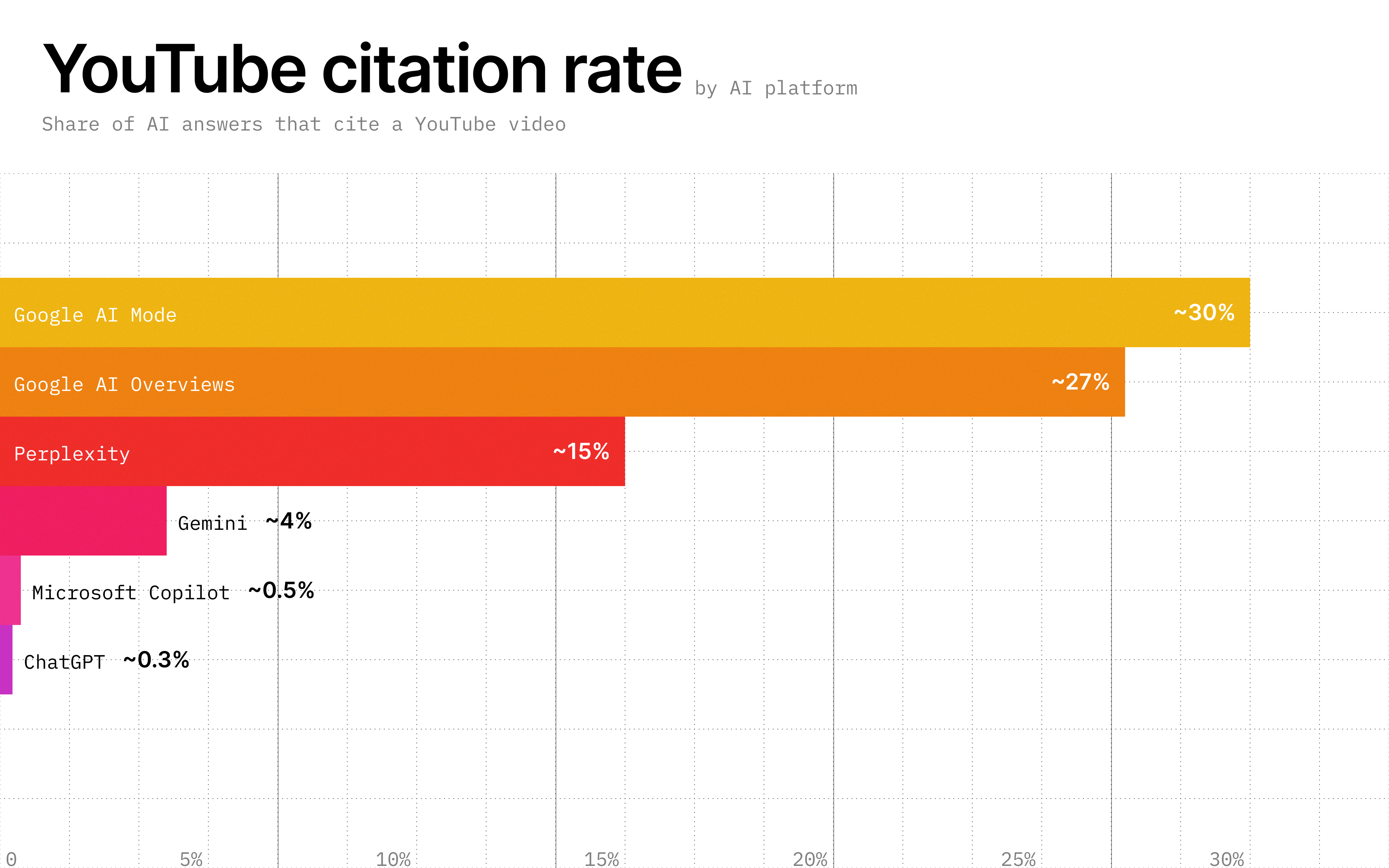
The lift is concentrated across the four AI platforms most likely to cite YouTube to begin with: Google AI Mode, Google AI Overviews, Perplexity, and Gemini. Platforms like ChatGPT and Microsoft Copilot rarely cite YouTube.
Google AI Mode had a ~30% YouTube citation rate, followed by Google AI Overviews at ~27%, Perplexity at ~15%, Gemini at ~4%, Copilot at ~0.5%, and ChatGPT at ~0.3%.
A note on the AI assistants we measured
Our research is based on AI answers that we could measure in the same way across our three-month window. While Claude, Grok, and Meta AI search the web and cite sources, for various reasons (e.g., answering too often from training versus real-time retrieval), they didn’t qualify for this study.
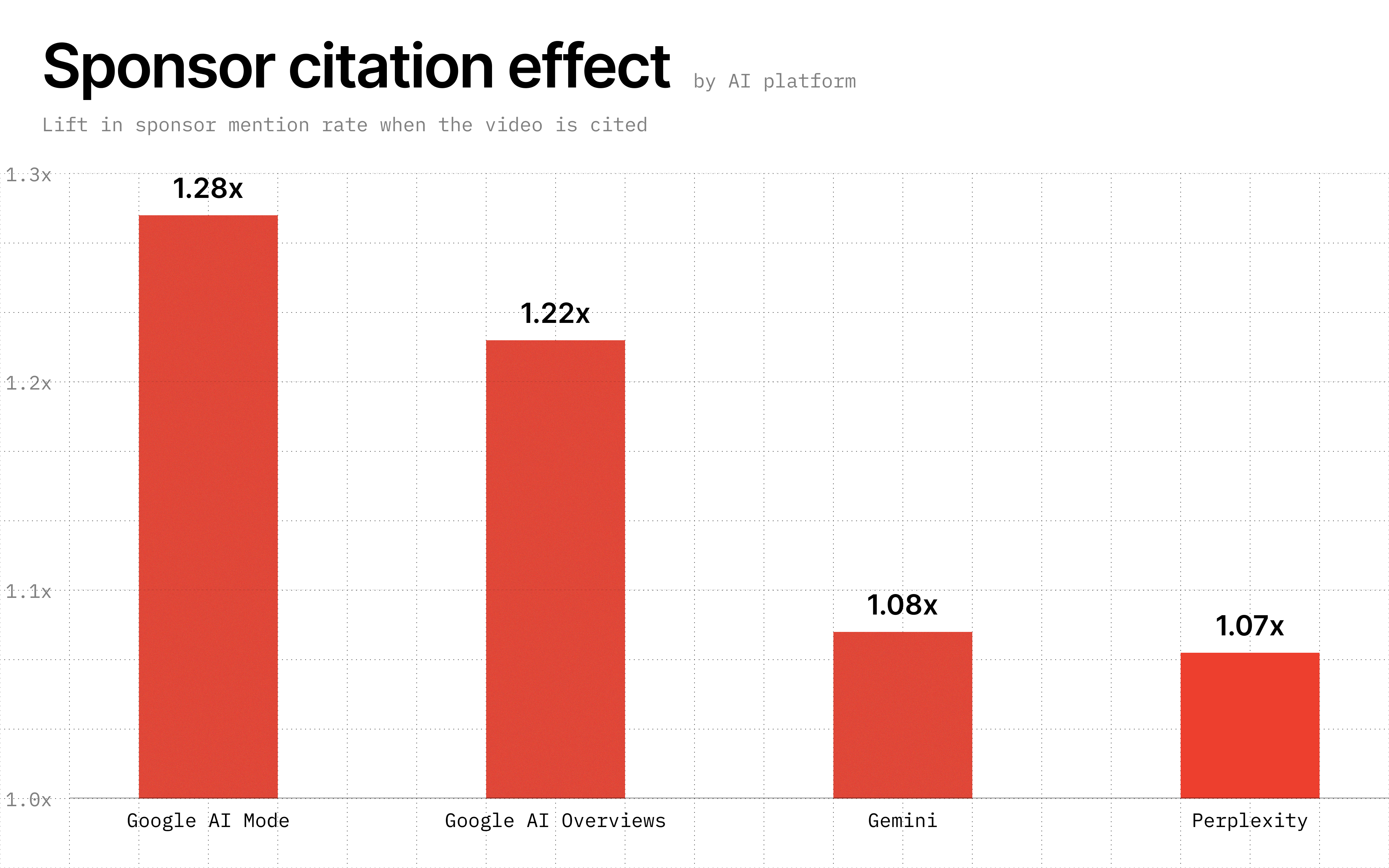
Google’s AI Mode and AI Overviews were the heaviest carriers of the effect. YouTube citations resulted in a 1.28x lift in brand mentions in Google AI Mode and a 1.22x lift in AI Overviews. Gemini and Perplexity had smaller per-citation lifts, coming in at 1.08x and 1.07x, respectively.
A note on shifting retrieval pipelines
Around August 12, 2026, Perplexity stopped citing YouTube almost entirely. Over the same period, YouTube's share of citations across Google's AI surfaces went up. ChatGPT and Copilot still rarely cite YouTube.
Remember: Retrieval pipelines can change under you. Use a tool like Scrunch to see how citations are performing right now for the prompts you care about.
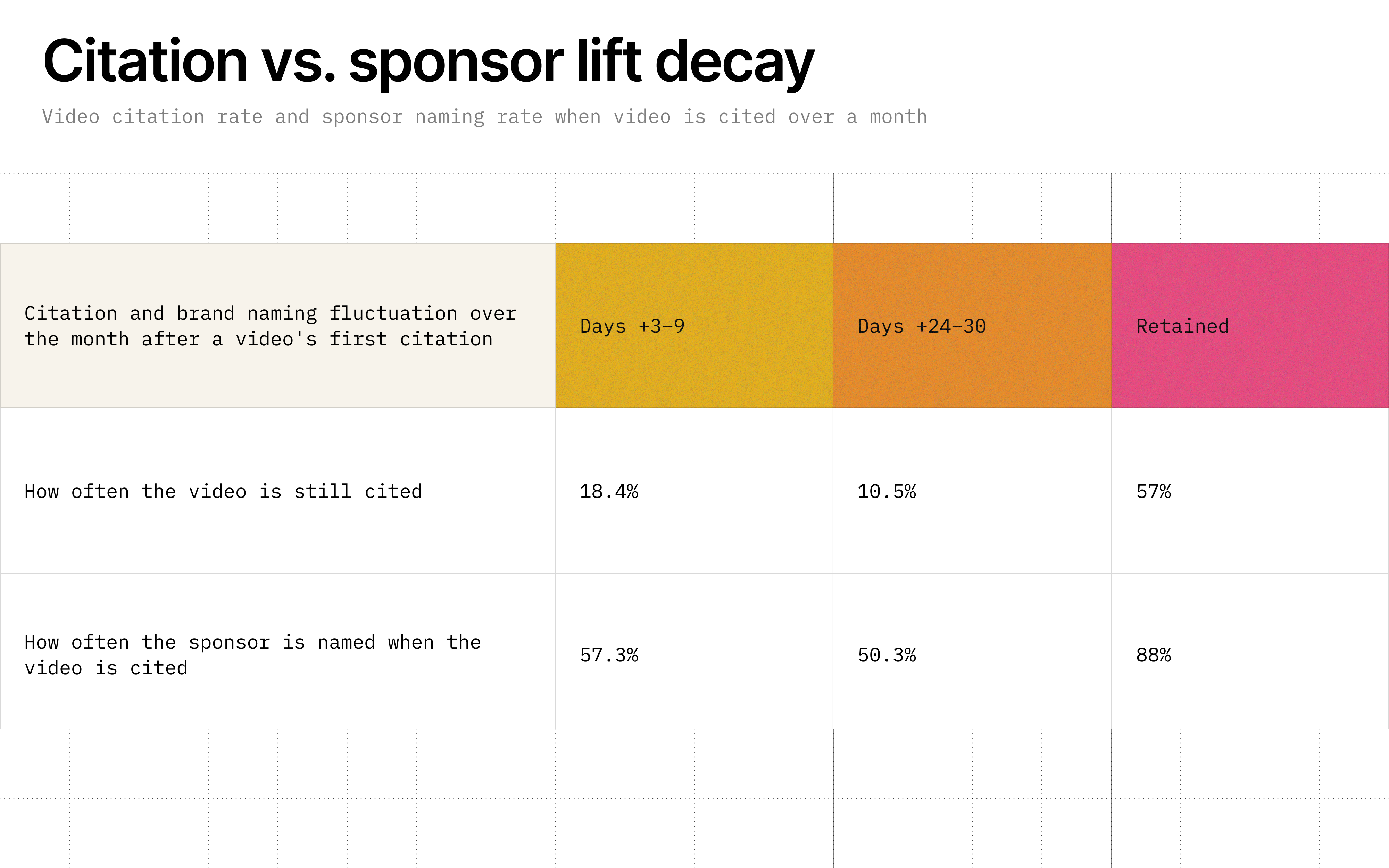
We also found that YouTube citations fade by roughly 43% within a month, going from an 18.4% citation rate to 10.5%.
The payoff holds up much better than the citations do. When a sponsored video does get cited, the sponsor still gets named about as often as before: That rate drops only about 12%, from 57.3% to 50.3%. However, fewer citations means fewer chances for sponsor brands to benefit.
This timeline is based on the first time the AI ecosystem started citing the video in our data. It’s not the day the sponsorship was filmed or paid for—sponsorship was already in place from upload. What we measured was the moment the sponsored video entered AI retrieval and what happened next.
Why do YouTube citations fade within a few weeks?
We don't know with certainty. The most likely explanations are retrieval recency (newer videos rotate in to displace older ones), AI ecosystem changes (the AI assistants update their indexes and rankings frequently), or topical drift (the topic cluster's prompts shift over time). The fade shows up broadly across the sponsorships we tracked, not in a handful of them, so it’s not a one-off pattern.
While a one-month cliff may sound fleeting, keep in mind that all citations come with a countdown clock.
Our study with Stacker revealed that, for the average citation source, citation activity drops by half in about 4-5 weeks. Source half-life is dependent on the AI platform, the industry, and the source itself, but relatively quick shifts in citation activity are normal.
At any rate, our research suggests that YouTube influencer sponsorships may create value outside of the human view count in the form of AI-answer exposure.
The point: For creators and YouTube partners, AI citations can become part of the sponsorship value story they offer to brands. And for brands and the agencies that serve them, campaign reporting can track whether sponsored videos are getting cited in AI answers.
What the YouTube-to-AI answer lift looks like in practice
Imagine you run influencer marketing at a wireless-speaker company.
You pay a tech YouTuber to mention your products in a video about home audio equipment. The video’s description says, "Thanks to Brand X for sponsoring this video. Get 10% off at brandx.com/creator."
A couple of weeks later, someone asks one of the major YouTube-citing AI assistants something like: "What are the best wireless speakers under $300 for an apartment with spotty Wi-Fi?"
The AI assistant searches, picks a few sources to cite, and includes your sponsored video as one of them.
When the AI writes its answer, your brand gets a name-check about 40% of the time (versus only about 32% of the time when the same AI assistant, asked the same question on a different occasion, doesn’t cite the video).
Big picture: A brand that sponsors a YouTube video isn’t just buying an influencer ad anymore. They’re also potentially buying more visibility in a second, increasingly crucial channel: AI search.
Is the mention just because the sponsor was already topically relevant?
This is partly handled by design in our measurement. The cross-sectional headline holds the same prompt and the same AI assistant constant, so any reason the brand was already topically relevant for that prompt would also push the control side up (it doesn't go into the "lift").
That said, there are two things we can't fully rule out. We can't separate "the brand paid for this" from "the brand's name sits high in the description, repeated, next to a discount code." A brand written that way without paying might get a similar bump. And if a brand happened to be in the news the same week its video started getting cited, our design wouldn't cleanly separate that either.
How to act on the lift (or decide if it’s yours to chase)
We’re not saying every brand should run out and start sponsoring YouTube influencers to juice their AI search performance.
But here are some tips for how to act on this information, whether you’re running YouTube influencer campaigns today or thinking about it.
Figure out how important YouTube is to your prompts
“Helpful for AI search” doesn’t necessarily mean “helpful for you.”
YouTube may not matter all that much for your particular prompt set. Use a platform like Scrunch to find out how influential YouTube is for the prompts you’re tracking.
If YouTube doesn’t move the needle for the prompts you care about, that doesn’t mean it’s a bad investment for marketing outside of AI search. It just means you shouldn’t count on it to pull double duty.
Lean on the description box
The lift we found lives in the YouTube description box. Getting your name into the text under the video is the part that we can show increases brand mentions.
So make description text part of the deal with any influencer you work with, not an afterthought.
When you brief your YouTuber, spell out exactly how your brand should appear in the description. The voiceover sells the humans watching. The text sells the AI reading.
Focus on unbranded prompts
The lift is bigger when your brand isn’t the obvious answer. If someone typed your name into AI search to begin with, AI was almost certainly going to talk about you anyway.
Unbranded prompts are where AI is genuinely shopping. A cited video that names you can tip the response your way.
And remember: Focusing on unbranded prompts is a good practice well beyond YouTube. You want to make sure AI answers about your brand are positive and accurate, yes, but first you have to make sure AI mentions you at all.
Don’t set and forget your citation strategy
YouTube or not, citations are on a timer.
That means the sources shaping AI answers today may not be the ones shaping them next month. A video, article, or page that's driving your mentions right now can get displaced as newer content rotates in and platforms update their indexes.
So treat citation tracking as ongoing, not one-and-done. Learn which sources feed the prompts that matter most to your business, watch for when those citations shift, and move fast when an important one drops out.
Don’t sleep on your own website
Third-party citations are critical, but owned content is another piece of the puzzle.
Your website is the one source you control completely. The problem is that most sites are built for humans, not AI. If AI can't read it, it won't cite it.
Invest in tooling that helps you optimize your site for AI retrievability and citability. Whether the issues are technical or editorial, you need to know what to fix to make your site as easy as possible for AI to consume.
Every sponsored YouTube video has two audiences now: the humans who watch it and the AI bots that read it.
You're already paying for the first. Scrunch helps you find out if you’re benefitting from the second.
Build a better citation strategy with Scrunch
Track and win the sources that shape AI answers. Start a 7-day free trial or get in touch to see how Scrunch can help you optimize your approach to AI citations.
A quick note on our methodology
How we tested this:
- We checked it two ways, using data from May 2026 to July 2026.
- First, we looked at the same question asked of the same AI assistant many times over. Sometimes the answer cited the sponsored video and sometimes it didn't, so we compared those two groups. Holding the question and the assistant fixed is what keeps the comparison fair:Aany reason a brand was already a likely answer to that question pushes up both sides, so it doesn't show up as lift.
- Secondly, we followed videos through the month after an AI assistant first cited them, tracking two things separately: how often the video was still getting cited, and how often the sponsor got named in the answers that cited it. That's what tells us how long the payoff lasts.
What we counted:
- The sponsor's name in the answer text, not coupon codes, URLs, or the sponsor's own phrasing. Whether the brand name shows up is the whole outcome.
- Sponsorship language in the video description. We read the text under the video, never the audio.
What to keep in mind:
- Observational, not experimental: We measure correlation in carefully stratified subsets. Nobody randomized which videos got sponsored.
- Conditional on a citation event: The lift only fires when the video is cited. What a campaign is worth also depends on how often that happens, which is a separate question.
- The citations fade, the payoff mostly doesn't: Over the month after a video's first citation, how often it's still cited falls by more than 40%. The rate at which the sponsor gets named when the video is cited holds about 88% of where it started.
- Scope: This is about the AI surfaces that cite YouTube. Google AI Mode, Google AI Overviews, Perplexity, and Gemini carry essentially all of the YouTube citations we see, and we measured all four the same way across the full three months. ChatGPT and Microsoft Copilot are in the numbers as the contrast: They almost never cite YouTube.
- Sponsor detection is narrow: Under 1% of cited YouTube videos carry explicit sponsorship language naming a brand in the description. Sponsorships disclosed only in the voiceover are invisible to us, and we can't say which way that tilts the headline.
- Mention rates were already rising before citation: In the three weeks before a video's first citation, sponsor mention rates were climbing by roughly as much as the jump that follows. A simple before-and-after would credit the citation with a rise that was already underway, which is why we report per-citation figures instead.
- Placebo brand: We ran the same analysis looking for an unrelated brand's name in place of the sponsor's, and the association disappeared. That rules out AI answers simply naming more brands whenever they cite a commercial video. It doesn't separate paying from placement.
- "Unbranded" means the prompt doesn't name the sponsor: On prompts that do name it, the sponsor appears in about 99.9% of answers whether or not the video is cited. There's no headroom left, which is why the 1.35x belongs to prompts that don't name you.
- What this design can't show: whether paying is what does it, or whether having your name high in a description next to a discount code would do the same on its own. The description box is the only part of a video we read. And nothing here speaks to clicks or sales.
- External validity: These results describe the AI ecosystem from May to July 2026, and it keeps moving. Around August 12, Perplexity stopped citing YouTube almost entirely. Read the levels as a snapshot and the mechanism as the finding.
Data studies


More articles

Surviving the clickpocalypse: What millions of search events say about AI eating the news

The AI confidence trap: Key takeaways from our 2026 AI search survey
